Reporting from the Front Line: Ukraine’s other war against corruption
In Kharkiv Oblast, a village located 30 kilometers from the hottest frontline in Europen our journalist Paolo Zurlo met Vitalyi Shabunin, Ukraine’s most vocal anti-corruption activist. Together with Giovanni Kessler (former EU Anti-Corruption Office Director) and activists from the European Nonviolent Action Movement, Paolo asked Shabunin about another, less visible war that has been afflicting the country: the resistance of the Ukrainian people against political corruption.
Author: Paolo Zurlo
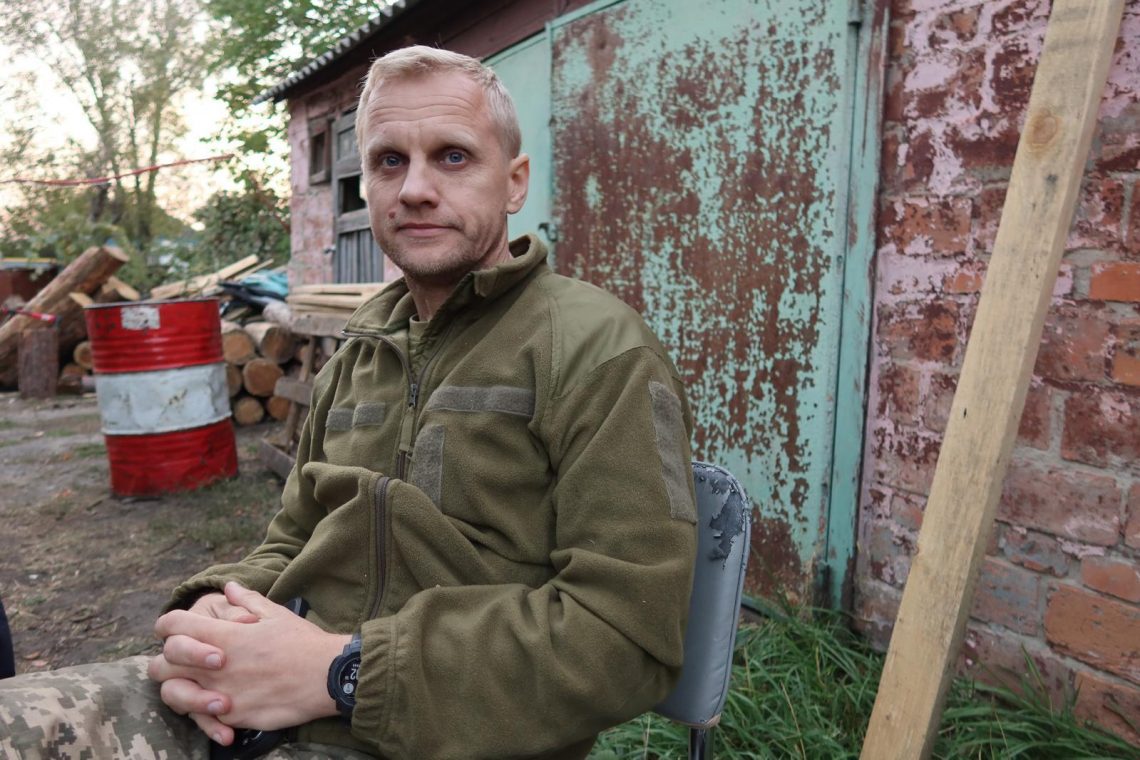
Photo credit: Vitalyi Shabunin, co-founder of AntAC, Ukraine’s leading corruption NGO. @Paolo Zurlo
Shabunin is the co-founder of AntAC, Ukraine’s leading anti-corruption NGO. He founded the organisation in 2012, he explained, when he was involved in regional politics and Yanukovych was still president. “In that setting, I realized that corruption was the biggest problem in Ukrainian society, as it wasn’t just a tool of political power, it was its very core”. According to him though, today things are much better, and the situation is incomparable to ten years ago.
“Such radical change,” Shabunin says, “is a direct consequence of Euromaidan, as it effectively dismantled the former political system”, which ended in 2014 after President Yanukovich ordered the security services to open fire on the rioters, and then suddenly left the country, seeking exile in Moscow. Shabunin continued: “After the Revolution of Dignity we’ve created strong judicial institutions — NABU and SAPO —which can provide independent investigations. We also created the possibility for the media to uncover corruption and speak freely about it”. This way, he added, AntAC made it extremely hard to hide corruption from society: “in fact we also instituted one of the best systems in the world for politicians’ asset declarations. This way we are able to prosecute top politicians, which was fundamentally impossible ten years ago”.
On July 22, however, the National Anti-Corruption Bureau (NABU) and the Specialized Anti-Corruption Prosecutor’s Office (SAPO) suffered an unprecedented institutional attack: the day before Parliament’s summer recess, the governing majority approved a law containing an amendment that stripped NABU and SAPO of their autonomy. “This law gave the Prosecutor General, who is a political appointee, the power to suspend or close any investigation”. President Zelensky signed the law that same day. Still, thousands of Ukrainians took to the streets in Kyiv, Lviv, and Odessa to defend the rule of law, in what felt like a revival of the Euromaidan spirit. Following the protests, on July 31 the government passed a new law restoring the independence of the two bodies.
According to another AntAC activist we met in Kyiv, «the government backed down because the European Union cannot accept such anti-democratic restrictions: they would hinder Ukraine’s path toward integration». Indeed, on October 1, EU Enlargement Commissioner Marta Kos visited Kyiv to meet with AntAC members and the heads of NABU and SAPO. Despite the easing of the legislative conflict following the street protests, Shabunin states that “The government has not reduced attacks against NABU and SAPO, it has only changed tactics. They are now trying to pass a law that would allow the Security Service (SBU) to block any investigation into a politician for ‘counterintelligence’ reasons”. What worries Shabunin most, however, is not the use of legislative power to attack institutions and protect political allies: “everyone in politics has played that game, that’s not a red line. The problem is the structural use of threats and intimidation against NABU and SAPO activists and investigators”.
On July 21, NABU investigator Ruslan Mahamedrasulov was imprisoned, “on clearly falsified evidence”, says Shabunin. Mahamedrasulov was leading an investigation into Timur Mindich, a well-known entrepreneur and long-time friend of President Zelensky. At the time of his arrest, the SBU conducted 80 searches of NABU’s offices, accusing the independent body of being infiltrated by Russia. Mahamedrasulov was then pre-emptively jailed on charges of illegal trade, accused of being an intermediary for the sale of batches of industrial hemp to the Republic of Dagestan (Russia), on behalf of the father, who runs a legal cannabis business. According to AntAC and Shabunin, however, the evidence is fabricated, and the father’s trade was not with a client from Dagestan, but from Uzbekistan, with no ties to Russia. The Prosecutor General’s office, however, has repeatedly postponed the analysis of the call that was registered by the SBU and used as evidence.
In the meantime, the detective and his father are still in jail. “This is the red line of a democracy: throwing a detective and his father in jail on a clearly falsified case, and Zelensky decided to cross it. That’s the clear difference between the previous president — who hates me — and this one — who hates me too: it’s a tradition apparently”. Shabunin’s joke is grounded in his personal experience of state intimidation over the years: from public aggressions to smear campaigns on social media, and even an arson attack on his home in 2020. Last summer he was accused by the State Bureau of Investigation of military draft evasion, with many national and international human rights organisations denouncing the prosecution as politically motivated. The Prosecutor’s office had then temporarily suspended the investigation right after the mass protests that followed the attack on NABU and SAPO, however the State-controlled media had already tried to tarnish his reputation. Eventually, he was intentionally deployed in Kharkiv Oblast, some 30 kilometres from the frontline, where he is now kept under observation by the security services: “I’m used to this, I’ve been living in a tough environment even before the war”.
Before we leave, he reminds us of AntAC’s mission: “It is our duty to protect the independent bodies we have created. Ukraine is a young democracy, so first, we must rid ourselves of the
Russians, and then build strong institutions to safeguard the rule of law”. This is perhaps the most striking aspect of the story. Despite the difficulties in which he operates, Shabunin does not cease to affirm what is the common sentiment of the people: the Russian invaders must leave. None of the democratic ideals cherished by millions of people can be realised if the war continues and Ukraine does not have the strength to remain sovereign and independent. The corruption it suffers from, after all, is the legacy of seventy years of the Soviet Union. It is this heritage that Ukrainians wish to emancipate themselves from.
Thanks to AntAC and popular protests, independent institutions endure, but if the European Union truly cares about Ukraine’s democratic future, it should keep a close watch on its rule of law, and on how many more “red lines” are to be crossed.

