The Human Cost of the War on Drugs: A Critical Reflection on Felipe Calderón’s Visit to Sciences Po
Over the past two decades, violence has spread across Mexico, intensifying in waves as organized crime, weak institutions, and militarized security policies intersected, reshaping everyday life and leaving communities exposed to insecurity and fear. This escalation was particularly marked during the presidency of Felipe Calderón, whose so-called “war on drugs” deployed the military nationwide and set the stage for the violence and institutional fragility explored in this text. This article is the first in a series exploring Mexico’s struggles with narco violence, insecurity, and the human impact of organized crime, from articles, personal experiences and the families searching for the disappeared.
Author: Lucia Aguilar
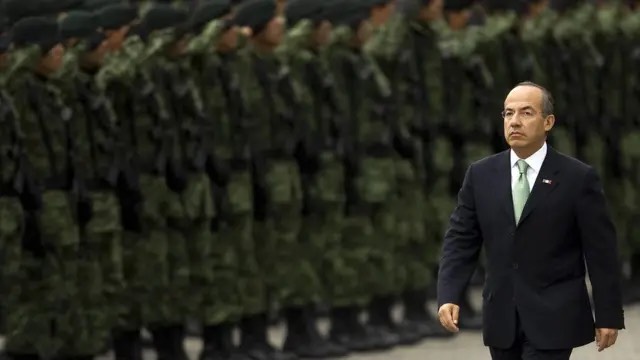
Photo credit: Felipe Calderón during the early phase of Mexico’s war on drugs (photo by AFP, via BBC News Mundo)
I grew up in Xalapa, Veracruz, in southern Mexico. My parents relocated there in the early 2000s, seeking a city with lower levels of pollution, abundant green spaces, and proximity to the coast, everything the dense and urban Mexico City is not. They uprooted their lives without knowing that it would become one of the most dangerous states in the country. I was in elementary school when the “war on drugs” was introduced to the public consciousness in 2006 by President Felipe Calderón. Immediately after taking office, Calderón deployed tens of thousands of soldiers and federal police across the country, framing drug trafficking organizations as an internal enemy to be defeated through force. This strategy relied on military deployment, joint operations, and the targeting of cartel leaders, known as the “kingpin strategy.” While it aimed to weaken organized crime by dismantling its leadership, it largely ignored institutional reform, local governance, and social prevention mechanisms.
Felipe Calderón will visit Sciences Po this week. Upon this occasion, it is crucial to critically examine the legacy of his presidency, and particularly his war on drugs. Often presented as a necessary security strategy against organized crime, this policy not only resulted in mass human suffering, including widespread violations of human rights and Mexico’s obligations under international law followed by more than 280, 000 deaths, but also failed to improve public security. On the contrary, it contributed to a fragmentation of criminal groups, an escalation of violence, and a long-term deterioration of safety conditions in Mexico.
From a security perspective, the results were devastating. As leaders were captured or killed, splinter groups emerged, competing violently for territory, trafficking routes, and local control. This competition intensified violence, particularly at the local level, and expanded criminal activity into extortion, kidnapping, fuel theft, and human trafficking. In other words, organized crime became more decentralized, more unpredictable, and more embedded in everyday life.
From personal experience, the escalation of violence upended the safety of everyday life in Veracruz. School days were frequently disrupted due to nearby shootings, and families, including my own, were forced to establish strict precautions to avoid interaction with law enforcement or criminal networks. I had to navigate my early teenage years with particular caution, taking care to avoid associations that might expose my friends’ families to the influence of organized crime. Out of an abundance of caution, social activities were highly regulated, with restrictions on staying out late and limitations on travel in friends’ vehicles. My parents tried to shield us from the worst of it, but the fear that permeated our community was impossible to hide. Lifeless bodies were hung from bridges in busy avenues, and violence became so normalized that even kidnappings were discussed casually. A friend of mine, who had been abducted, later stated that “they gave me pizza and only beat me sometimes,” and we all internalized it as if it were ordinary.
Homicide rates more than doubled during Calderón’s presidency, with drug-related killings increasing sharply after 2007. Upon relocating to Mexico City for my undergraduate studies, I encountered people from other regions of the country and recognized that my experiences in Veracruz were not unique. Similar patterns of exposure to violence and insecurity were evident across multiple states. Humor was often employed as a coping mechanism, as if humor could soften the weight of fear. It was through these interactions that I understood that no one in Mexico truly avoided facing this reality. Violence has seeped into the way we grow up, it permeates everyday life in Mexico, shaping socialization and the rhythms of daily existence.
During the war on drugs, entire regions that had previously experienced relatively low levels of violence, such as parts of northern and central Mexico, became epicenters of armed conflict. Militarization did not restore order; it transformed many areas into permanent zones of insecurity.
At the same time, the use of the armed forces for public security tasks weakened civilian institutions. The military, trained for combat rather than policing, was placed in charge of law enforcement functions without adequate accountability mechanisms. This resulted in widespread human rights violations, including extrajudicial killings, torture, and enforced disappearances. Crucially, these abuses undermined public trust in the state, making cooperation with authorities more difficult and further eroding security.
Impunity became a central feature of the conflict. Judicial institutions were overwhelmed and incapable of processing the surge in violence, while corruption persisted at multiple levels of the government, including within the security apparatus of the Calderón administration. As a result, crimes went unpunished, reinforcing criminal power and sending a clear signal that violence carried few consequences. This dynamic was later underscored by the conviction of Genaro García Luna, Calderón’s former Secretary of Public Security, in a U.S. federal court for collusion with the Sinaloa Cartel. Security, rather than being strengthened, became increasingly fragile over time.
The long-term consequences are still visible today. Mexico remains one of the most dangerous countries in the world outside of active war zones. Armed forces continue to play a central role in public security, and violence has become normalized in many regions. The war on drugs not only failed to dismantle organized crime; it reshaped it into a more violent, diversified, and territorially entrenched threat. Subsequent governments failed to reverse this trajectory. The administration of Enrique Peña Nieto promised a shift away from open confrontation but largely maintained militarization, while prioritizing the management of violence rather than its causes. Andrés Manuel López Obrador later introduced the obsolete discourse of “abrazos, no balazos” (hugs not bullets), emphasizing social programs and restraint; however, the role of the armed forces expanded further, and levels of violence remained high. Under the current administration of Claudia Sheinbaum, there has so far been no clear break with this security paradigm, nor strong actions to combat organised crime.
Calderón’s visit to Sciences Po offers an opportunity to engage critically with real-world security policy and his role in facilitating the deterioration of security in Mexico. While I experienced first-hand the unsafe world he created through his war on drugs, I am not the only one who experiences profound anger and disappointment with his presence. His presidency illustrates how militarized responses to crime can backfire when they prioritize force over institutional reform, prevention, and social investment.
Critically examining and making it known that Calderón’s strategy is not an exercise in ideology, but also accountability. For students of Public Policy, International Security, International Governance and Human Rights and Humanitarian Action, Mexico’s experience serves as a warning: when security is pursued without strengthening institutions, protecting civilians, and addressing structural inequalities, violence does not disappear, it multiplies. Security policies must be evaluated not only by their intentions, but by their outcomes.
Mexico is deeply entrenched by insecurity, marked by territorial control by criminal groups, the illegal recruitment of children and adolescents, the existence of clandestine training sites and crematoriums, over 130,000 missing persons and big institutional neglect, to say the least. While subsequent administrations also bear crucial responsibility for Mexico’s current situation, Calderón’s visit reminds us of the power he wrongfully exercised, the violence his strategy unleashed, and the enduring consequences that must remain in our collective memory – consequences for which he bears direct responsibility, yet continues to avoid, far from the communities he devastated.

