Frederiksen in Paris: ‘The global order is over. Let’s rearm now.’
Danish Prime Minister and Greenlandic Prime Minister speak at Sciences Po on US pressure.
Author: Filippo Vezzoli
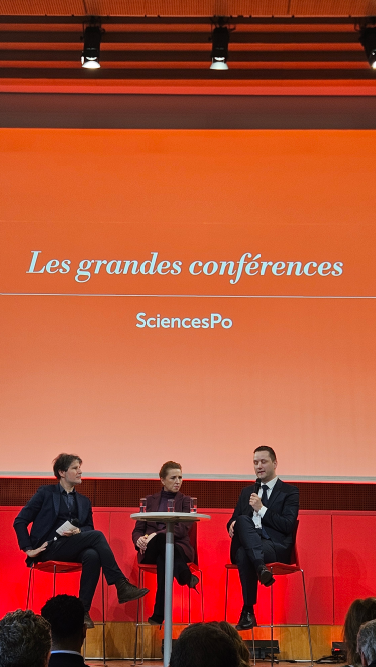
Photo: Giuliano Da Empoli with Danish Prime Minister Mette Frederiksen and Greenlandic Prime Minister Jens- Frederik Nielsen at Sciences Po, Paris, 28 January 2026.
Paris, 28 January 2026, 9:00 a.m.
It was a more political morning than usual at the Paris Institute of Political Studies (Sciences Po), which served as the stage for new statements by Danish Prime Minister Mette Frederiksen and Greenlandic Prime Minister Jens-Frederik Nielsen. They were welcomed by Giuliano Da Empoli, professor and Italian author of the French-language novel Le Mage du Kremlin (The Wizard of the Kremlin), which inspired the film of the same name that is being released in European cinemas in these days. In the 7th arrondissement of Paris, however, Da Empoli and the two Prime Ministers, who landed in the French capital after their stop in Berlin to meet with French President Emmanuel Macron, did not talk about the threat from Russia narrated in the pages of the Italian’s novel. In a way that would have been unthinkable for any political analyst until a few years ago, the discussion focused on Donald Trump’s intimidation tactics regarding his desire to “acquire” Greenland for national security reasons. Although tensions eased last week following Trump’s statement that a preliminary agreement would be discussed with NATO Secretary General Mark Rutte, the American President’s words did little to reassure the Danish and Greenlandic leaders, currently on a European tour to meet with the EU’s top leaders.
Frederiksen, leader of the Danish Social Democrats since 2015, reiterated a strong message for the entire continent. ‘The global order as we know it, and which we have defended since the Second World War, is over,’ said the Danish Prime Minister, leaving no room for ambiguity about the state of the liberal international order promoted by the United States after 1945, which has been slowly but steadily disintegrating under its own promoter. Donald Trump, who took office for his second term in the White House in January last year, has shaken up the ministerial offices of rivals and allies by adopting an aggressive foreign and trade policy that has effectively normalised the use of duties and tariffs. His claims on Greenland, an autonomous territory of the Kingdom of Denmark, which he initially said he wanted to acquire at all costs, even by force if necessary (a statement later denied during his speech at the World Economic Forum in Davos, Switzerland, last week), drew criticism from many Atlantic allies, whom the American president then threatened with 10% tariffs for sending troops to the Arctic island for an exercise.
The Prime Ministers agreed on the dialogue with the US regarding an agreement: ‘We are in contact with the Americans, and we will continue to dialogue for an agreement. It’s like a book that we have to write together, with the help of our European neighbours,’ said Frederiksen, arguing that it is time for Europe to mobilise in defence of its territorial sovereignty and international relevance. One thing is certain for Frederiksen: Europe must write this “book” together, but ‘the conclusion is already written: we will not compromise on our democratic values, otherwise it’s game over.’ ‘You don’t threaten your allies,’ is the Danish Prime Minister’s message.
‘We will always be grateful to the Americans for liberating Europe from Nazi-Fascism, and I believe in transatlantic friendship, but we must be realistic: the gradual disarmament of Europe was a mistake,’ Frederiksen continued. The priority is ‘to rearm now, not by 2035,’ as decided by NATO allies at The Hague Summit last June. ‘In 2035, it will be too late. If we are not willing to defend ourselves and risk paying a higher price’ for our security, ‘what are we?’
Greenlandic Prime Minister Nielsen expressed sympathy towards Europe, emphasising that Greenland is ‘aligned with the European Union and NATO, while having a unique culture.’ The 34-year-old, who has been head of the Greenlandic government since April 2025, said that Greenlandic public opinion has moved much closer to Europe in recent months, and ‘even the debate on possible EU membership’ has returned to the political arena. ‘We need a strong and united Europe, and we are looking for partners who share our core values. A partner with our values would never threaten an ally.’ The Prime Minister also cited the risks associated with excessive consumption of digital platforms, and was the protagonist of an amusing interlude: « My 15-year-old daughter always shows me videos made by artificial intelligence and posted on the internet about me. It’s crazy! In one, I was in a frozen wasteland, being chased by Donald Trump riding a polar bear! » With international tensions on the rise, the risks associated with artificial intelligence and the spread of false or modified content are only eroding social cohesion, which is already precarious at European and global level. Meanwhile, as Frederiksen and Nielsen have said, Europe will undoubtedly have to face an existential dilemma: defend its democratic values or pander to the “national interests” of its historic ally?

