
Retour sur le Grand O de Christophe Castaner
Mercredi soir, le Grand Oral faisait sa rentrée. L’invité choisi pour ouvrir le bal n’était autre que Christophe Castaner, porte-parole du gouvernement. Cette première édition, qui s’est tenue dans un contexte de revendications sociales et de protestations, s’est révélée mouvementée. Dix minutes après le début de l’événement, un groupe d’étudiants, militant contre les ordonnances sur le Code du Travail, ont laissé entendre leur mécontentement en faisant interrompre l’interview politique. Il faut dire que les ordonnances que prévoit le gouvernement ne plaisent pas à tout le monde ; la cote de popularité du Président a baissé jusqu’à atteindre 30% ces derniers jours. Dans une atmosphère parfois électrique, le Grand Oral s’est chargé de questionner le porte-parole du gouvernement sur de nombreux sujets tant politiques que personnels.

How eCOGRA Certification Shapes Payout Standards in Canadian Online Casinos, According to Casimatic
When Canadian players evaluate an online casino, payout speed and reliability rank among the most scrutinized factors. Behind many of the industry’s payout benchmarks sits a certification body that has quietly shaped operational standards for over two decades: eCOGRA, short for eCommerce Online Gaming Regulation and Assurance. Founded in 2003 and headquartered in London, eCOGRA emerged at a time when online gambling regulation was fragmented and player protections were inconsistently applied. Its certification framework has since become one of the more meaningful third-party signals that a casino operates with financial accountability — particularly relevant for Canadian players navigating a market that lacks a single federal licensing authority for online gambling.
What eCOGRA Certification Actually Requires From Casinos
eCOGRA certification is not a one-time audit. Casinos seeking the organization’s « Safe and Fair » seal must undergo an initial assessment followed by ongoing monthly audits of their random number generators, game return-to-player (RTP) percentages, and financial processing procedures. The certification standard, formalized under the eCOGRA Generally Accepted Practices (eGAP) framework, requires operators to maintain documented payout policies, process player withdrawal requests within defined timeframes, and demonstrate that funds held in player accounts are segregated from operational capital.
The eGAP framework specifically addresses dispute resolution, mandating that certified casinos provide players with access to eCOGRA’s Alternative Dispute Resolution (ADR) service at no cost. This is not a minor administrative requirement. The ADR mechanism gives Canadian players a formal escalation path when a casino delays or disputes a payout — a situation that, without such a mechanism, would leave most players with no practical recourse beyond contacting a licensing authority in a foreign jurisdiction like Malta or Gibraltar.
On the RTP side, eCOGRA publishes monthly payout reports for certified casinos. These reports disclose the aggregate payout percentages across game categories — slots, table games, video poker — giving players verifiable data rather than marketing claims. Historically, certified casinos have published aggregate RTPs in the 96–98% range for slots, though individual game variance means these figures reflect long-run averages across millions of spins rather than session-by-session outcomes.
How Certification Translates Into Faster and More Reliable Withdrawals
The connection between eCOGRA certification and payout speed is structural rather than coincidental. Certified operators must maintain internal compliance teams capable of processing withdrawal requests and documenting outcomes. Casinos that fail to meet withdrawal processing benchmarks risk losing their certification — a consequence with real commercial implications, since the eCOGRA seal influences player acquisition and is referenced by comparison platforms and review sites across the Canadian market.
Casimatic, a casino comparison platform focused on the Canadian market, has noted that eCOGRA certified casinos with fast payouts in Canada consistently outperform non-certified competitors on measurable withdrawal metrics, including average processing times and the frequency of player-reported disputes. This pattern reflects the compliance infrastructure that certification demands rather than any inherent generosity on the part of individual operators.
The practical mechanics matter here. A casino that submits to monthly eCOGRA audits must maintain accurate transaction records and demonstrate that withdrawal queues are being processed in sequence. This creates an internal accountability loop that non-certified casinos operating under lighter-touch licensing regimes are not subject to. For Canadian players specifically, where provincial regulators like iGaming Ontario oversee a legal market but the grey market remains large, eCOGRA certification functions as a supplementary signal of financial reliability that cuts across jurisdictional lines.
It is also worth noting that eCOGRA’s testing laboratory is accredited under ISO/IEC 17025, the international standard for testing and calibration laboratories. This accreditation means that eCOGRA’s RNG testing methodology meets independently verified scientific standards — not just industry self-regulation. The distinction matters when evaluating whether a certified casino’s published payout percentages reflect genuine statistical outputs or selectively reported figures.
The Canadian Context: Provincial Regulation and Third-Party Certification
Canada’s online gambling landscape is structurally unusual. Unlike the United Kingdom, which operates a unified national licensing regime through the UK Gambling Commission, Canada delegates gambling regulation to the provinces. British Columbia operates PlayNow through the British Columbia Lottery Corporation. Ontario launched its regulated iGaming market in April 2022 under iGaming Ontario, a subsidiary of the Alcohol and Gaming Commission of Ontario (AGCO). Quebec, Alberta, and other provinces maintain their own lottery-operated platforms but have not replicated Ontario’s open licensing model for private operators.
This fragmentation means that a Canadian player using a privately operated online casino — legal under Ontario’s framework or operating in a grey zone elsewhere — may be dealing with an operator licensed in Malta under the Malta Gaming Authority (MGA), in Gibraltar, or in Curaçao. Each of these jurisdictions has different standards for player fund protection, withdrawal processing, and dispute resolution. eCOGRA certification, because it is applied at the operator level regardless of licensing jurisdiction, provides a layer of standardization that the regulatory patchwork does not.
Casimatic’s analysis of the Canadian market has highlighted that players in provinces outside Ontario face the greatest information asymmetry when selecting a casino. Without access to iGaming Ontario’s operator registry or the AGCO’s compliance framework, these players rely heavily on third-party signals like eCOGRA certification to assess whether a casino meets baseline standards for financial reliability. The certification’s ADR service is particularly relevant in this context, since players outside Ontario lack a provincial regulator with direct authority over private online casino operators.
The Ontario market itself has introduced additional complexity. iGaming Ontario requires registered operators to comply with the AGCO’s Standards for Internet Gaming, which include provisions on responsible gambling, advertising, and financial controls. Several operators active in the Ontario market also hold eCOGRA certification, creating a dual-compliance environment. In practice, the AGCO standards and the eGAP framework overlap significantly on financial accountability requirements, but eCOGRA’s monthly public reporting adds a transparency layer that iGaming Ontario’s framework does not independently replicate.
Limitations of Certification and What Players Should Understand
eCOGRA certification is meaningful but not unlimited in scope. The organization certifies operators based on the documentation and technical data they provide, supplemented by eCOGRA’s own testing. It does not function as a licensing authority and cannot impose fines or revoke operating licenses. When a certified casino is found to have violated eGAP standards, the primary sanction available to eCOGRA is withdrawal of the certification seal — a reputational consequence rather than a regulatory one.
There have been cases where casinos held eCOGRA certification during periods when player complaints about delayed withdrawals were publicly documented. Certification audits, even monthly ones, operate on a sample basis and may not capture every operational failure in real time. Players should treat certification as a positive signal that correlates with better average outcomes rather than a guarantee of flawless performance in every individual transaction.
Casimatic’s research also points to the importance of distinguishing between the eCOGRA « Safe and Fair » seal and the organization’s separate « Certified » designation for specific games. A casino may display eCOGRA branding because individual games on its platform have been certified for RTP accuracy, without the operator itself having undergone the full eGAP compliance assessment. These are distinct certifications with different scopes, and players comparing casinos should verify which designation applies.
Additionally, payout speed depends on factors beyond certification status. Payment method selection — bank transfer versus e-wallet versus cryptocurrency — affects processing times independently of a casino’s compliance posture. Casinos certified by eCOGRA that process withdrawals via bank transfer will typically take longer than non-certified casinos offering instant e-wallet withdrawals. Certification addresses the casino’s internal processing standards, not the settlement timelines of external payment networks.
Understanding how eCOGRA certification functions — what it requires, what it measures, and where its authority ends — gives Canadian players a more accurate framework for evaluating casino reliability than surface-level comparisons based on promotional offers or brand recognition. The certification’s value lies in the operational discipline it demands from operators and the independent verification it provides for payout data, both of which address real information gaps that exist in Canada’s decentralized gambling regulatory environment. Players who factor certification status into their decision-making, alongside licensing jurisdiction and payment method availability, are working with a more complete picture of the risks and protections involved.
Alstom/Siemens, une union qui fâche
Après le portrait haut en couleur dressé par Sciences Polémiques, on entre directement dans le vif du sujet avec l’interview politique. La question de l’affaire Alstom est rapidement mise sur le tapis. Rappelons que la compagnie de transport ferroviaire française va bientôt fusionner avec le groupe industriel allemand Siemens. Le français et l’allemand vont former, comme le souhaite Paris et Berlin, un « Airbus du rail ».
“ Le grand enjeu maintenant, c’est de créer un champion économique européen “
Cette opération inquiète les syndicats d’Alstom, qui voient déjà l’entreprise fondre dans cette fusion au profit de la compagnie allemande qui en reprendrait le contrôle.

Pour Christophe Castaner, cette opération aurait un objectif plus large : celui de créer un « champion européen », qui permettrait de remettre en place une politique industrielle européenne et de peser sur la scène internationale.
“ Il faut assumer les provocations, sans quoi rien ne peut avancer. “
Questionné quant à la nouvelle forme d’écriture dite inclusive pratiquée dans un manuel scolaire de CE2 de chez Hatier, Christophe Castaner ne condamne pas ce choix, et au contraire le revendique. En effet, le Secrétaire d’État affirme que nous vivons dans une société profondément marquée par les inégalités. Ce n’est donc qu’en assumant ce qu’il appelle ce genre de « provocations » que les choses pourront avancer, selon lui.
Un porte-parole à l’histoire atypique
Le Grand Oral fut également l’occasion de revenir sur le parcours de ce natif du Var. Souvent taxé de débonnaire, Castaner revendique sa volonté de ne pas changer, et de ne pas être « customisé ». Ayant obtenu son Bac en candidat libre, militant à l’UNEF, noctambule et joueur de poker, le porte-parole du gouvernement présente un parcours pour le moins atypique. Il explique qu’il a dû faire un choix entre sa vie nocturne et la politique. Pour répondre à ses détracteurs qui le qualifient souvent de simplet, il déclare qu’à Forcalquier, la ville dont il fut maire durant seize ans, on peut aussi s’élever socialement.
“ Emmanuel Macron a un toucher de balle extraordinaire. “
C’est non sans humour qu’il nous livre ensuite son ressenti sur le gouvernement actuel et son président. Le fol amour entre lui et En Marche tient encore, et ce malgré les hauts et les bas liés à la mise en application du programme. Il ne tarit pas d’éloge sur l’actuel Président de la République, qualifiant ce dernier comme “ étant au-dessus du lot “ et file la métaphore du foot en attribuant à Emmanuel Macron des qualités intellectuelles peu communes qu’il compare à un toucher de balle extraordinaire, tel celui de Zlatan Ibrahimovic.
“ On est dans un monde dingue, c’est à Paris que les lois décident de tout le système. “ Christophe Castaner, justifiant la primauté des accords d’entreprise sur les accords de branche
La soirée s’est poursuivie par l’arrivée du Grand Témoin, Benjamin Amar, responsable politique des revendications de la CGT. Ce dernier s’oppose farouchement aux ordonnances du Code du Travail. Dès le début, Benjamin Amar donne le ton et dit vouloir centrer le débat sur la question des ordonnances. Pour appuyer son propos, il fait appel à des études faites par le FMI et l’INSEE, qui dévoileraient toutes deux que « casser le code du travail ne crée pas de l’emploi ». Castaner inscrit quant à lui les ordonnances dans une politique plus globale, politique visant à recréer une confiance et booster l’attractivité économique française aux yeux des investisseurs étrangers.
« Passez donc le message à Jupiter »
Vient alors la question de la négociation sociale, qui pour Benjamin Amar n’est qu’une « fable ». Selon lui le Code du Travail est fondé sur une « clé de voûte » qui a pour vocation de protéger les travailleurs du rapport de subordination entre l’employeur et l’employé. Le dénaturer porterait préjudice aux droits des travailleurs. S’ensuit un échange plus ou moins musclé entre les deux hommes qui, s’ils se lancent des piques sur le ton de l’humour, ne semblent pas prêts à revenir sur leurs positions.
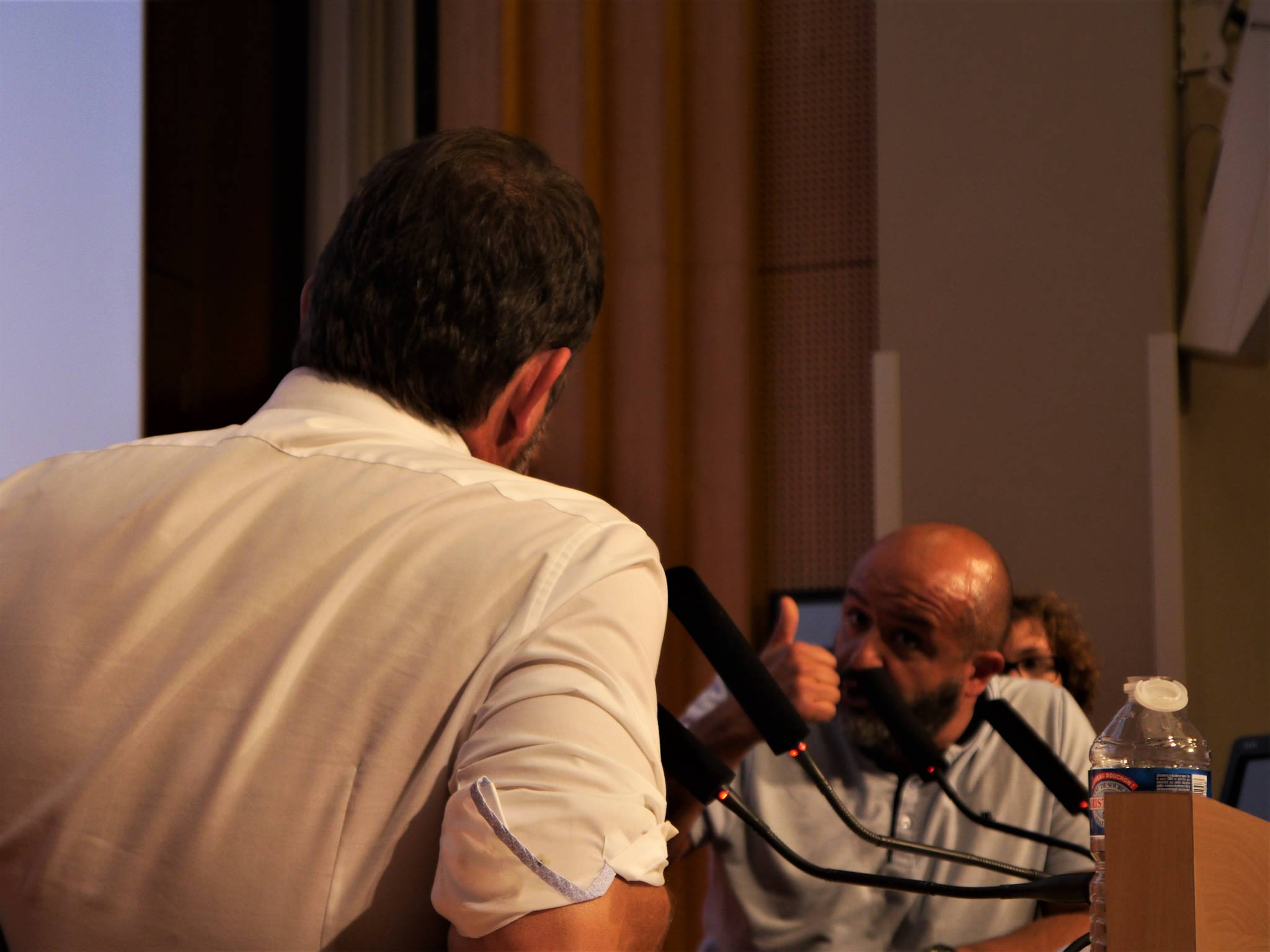
Le débat prend fin avec une conclusion pour le moins lapidaire de Benjamin Amar, conclusion directement adressée au président de la République : “ Passez donc le message à Jupiter (…) la foudre pourrait effectivement lui retomber dessus. “ Une formule applaudie par nombre d’étudiants dans la salle.
C’est donc dans une atmosphère plutôt tendue que cette première session de l’année s’est achevée. Notons cependant que le débat d’idées a pu avoir lieu jusqu’à son terme, en dépit de l’intervention des étudiants en début de conférence. Rendez-vous très bientôt pour un nouveau Grand Oral, le cycle ne fait que débuter !