Author: Max Cocard
Photo credit: « Ursula von der Leyen during the Choose Europe for Science event at La Sorbonne – 2025 (2) » by Christophe Licoppe / European Union, 2025 / EC – Audiovisual Service is licensed under CC BY 4.0. To view a copy of this license, visit https://creativecommons.org/licenses/by/4.0/?ref=openverse.
Since Donald Trump’s inauguration as the 47th President of the United States, the new government has increasingly attacked science and universities. This includes slashing funds for the National Institutes of Health, firing public agents at the Environmental Protection Agency, the Department of Health and Human Services, and the National Science Foundation, as well as threatening university fundings. In response, about 1,900 American scientists—all members of the U.S. National Academies of Sciences, Engineering, and Medicine—have published an open letter on March 31, 2025, in which they warn the public about the serious risks they incur. Many signatories fear job losses or political interference.
The past decade has seen a return to Great Power Competition, in which the major players of the international system turn increasingly competitive over regional and domain supremacy. Recognizing that climate change remains the biggest challenge of the century, policymakers must take incisive initiatives—attractive grant offers to foreign talent being one of them. China strives for global leadership in the green transition. It already controls, on average, two-thirds of the production of refining of major critical minerals such as lithium, graphite, cobalt, nickel and copper. And, in 2024, 28% of its final energy mix came from electricity, putting it ahead of the US and EU (22% and 21% respectively). Moreover, China ranks number one in the Nature Index for research output in chemistry, earth & environmental sciences and physical sciences.
In the scientific field, China is on the rise, while the US may be on the decline. So, where does that leave the EU? Can the Union reverse its historical scientific deficit from across the Atlantic? And will it be able to formalize a coherent strategy across all 27 member states? The time has come for the EU to realize that achieving strategic sovereignty can only be achieved through a European led decarbonization. Attracting the leading human capital on scientific research, essentially the brains behind the transition, will be essential to pursue this objective.
How the United States have come to rule the world academically
Since 1945, the US has benefitted from extraordinary progresses in scientific research, innovation and technology, spurring continued growth and competitiveness. Two factors seem to explain this success. First, a massive post-war investment in science and research, following American engineer, inventor and science administrator Vannevar Bush’s logic in Science: The Endless Frontier.
Second, appealing to the best talents worldwide has long been a successful strategy. Indeed, about 30% of Nobel Prize winners worldwide come from first-generation immigration. It appears that strong funding for basic research attracts the brightest young scholars from all over the world to the US. Consequently, where American universities become highly reputable, Nobel recognition follows, and the economy grows. This in turn allows for more resources, increasing interest for foreign students and scholars alike, and forming a virtuous cycle.
Van Zedwitz et al. also mention the strategic advantage of institutions possessing a strong track record of Nobel discoveries in this “war for talent”, otherwise known as brain drain—the migration of skilled workers in search of better standards of living and quality of life, higher salaries, access to advanced technology and more stable political conditions.
A European Endless Frontier moment?
Europe needs its own Endless Frontier moment. 2025 seems like a unique opportunity to benefit from a brain gain instead of the historic brain drain vis-à-vis the US, as American scientists are under ideological and budgetary pressure from their own government’s war on science. A March 2025 Nature poll shows that 75% of the 1,600 scientific respondents considered leaving the US. Favored relocation destinations appear to be Europe and Canada. Most interestingly, early career researchers were most tempted to move, as 79% of postgraduate respondents consider leaving.
Aware of the dire situation, Aix-Marseille Université launched its Safe Place For Science program. The aim is to attract American scientists by raising up to 15 million euros for a 3-year program in order to host around 15 researchers. The program quickly became a victim of its own success as it received over 300 applications. The same reality applies to other European research centers, for example the oncologist Johanna Joyce revealed that applications to her lab at the University of Lausanne have risen fivefold since January.
Attracting the best scientists requires resources and a plan. “Starting a new age of invention and ingenuity”, in the EU Commission’s president, von der Leyen’s words, means creating favorable conditions for researchers in order to engage and retain new talents. The European Research Area Act seeks to legally enshrine the freedom of scientific research, while the Choose Europe initiative proposes streamlined visa pathways. A new “scientific visa,” valid across all member states, is being prepared for 2025, aiming to simplify and accelerate the migration process for researchers. However, competition will be fierce as Australia, Canada, and China actively participate in the recent surge to attract American scientists.
A future guided by financial constraints and realistic ambitions
Europe’s ambition to become a global hub for science and innovation hinges on its ability to provide adequate financial support. While initiatives like the European Innovation Act aim to ease access to private capital, this alone is insufficient without a substantial boost in public investment. Currently, the Horizon Europe program allocates 93.5€ billion for research and innovation between 2021 and 2027. And the European Commission has set a target for member states to invest 3% of GDP in research and development by 2030, up from the current 2.2% but still below the US (3.5%) or Japan (3.3%).
Thirteen member states have called for increased funding and infrastructure to attract international researchers. An additional package worth €500 million has been announced for 2025–2027 to draw global talent. Crucially, the next Multiannual Financial Framework must reflect ambitious financing for the European Research Council. The challenge remains financial: stark salary disparities persist, with top US academics earning up to $1 million annually, far outpacing compensation at even Europe’s leading universities. Thus, extraordinary short-term funding needs to be enabled as well in order to not miss this exceptional window of opportunity.
This is a matter of grand strategy. Studies consistently show that top-tier research talent and institutions generate powerful spillover effects—spurring local economic growth and innovation through patent creation. As highlighted by a recent Bruegel publication, 9.3% of top US-based researchers and between 7% to 19% of postdoctoral researchers hold at least one degree from a European institution. Early-career scientists make the most realistic targets for relocation. Thus, targeting younger foreign researchers with European ties while ensuring that future talents remain on the old continent constitute two promising and realistic goals. By investing in the brightest minds of tomorrow, the EU can reaffirm its role as a beacon of hope for the ideas that came to shape the Scientific Revolution of the Renaissance.
]]>
Welcome Om, l’association de spiritualité orientale
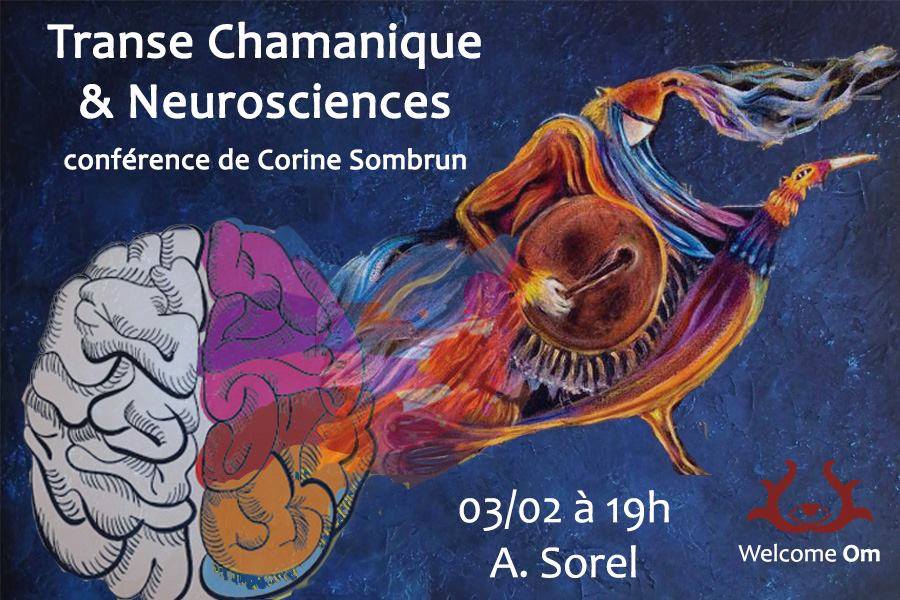
Créée et reconnue en septembre 2015, l’association Welcome Om est essentiellement composée d’élèves de quatrième année revenus d’une 3A en Inde ou en Thaïlande. Ils sont une dizaine à avoir répondu à l’appel de leur président Nicolas Pintea. Leur objectif est aujourd’hui d’initier les sciences-pistes à la culture et à la spiritualité orientales pour enrichir et compléter une formation très occidentale. « L’idée est de présenter d’autres façons de considérer sa réalité afin que chacun puisse y trouver des éléments de réflexion pour nourrir la sienne », explique Nicolas. La Péniche a tenté de comprendre certains secrets du mysticisme à l’occasion de leur dernier rendez-vous sur le thème Transe chamanique et Neurosciences.
Reportrice à la BBC, écrivaine, et chamane…
La conférence est présentée par Corinne Sombrun, réalisatrice de reportage pour la BBC. Elle est accessoirement écrivaine…et chamane. Elle entame sa conférence par une question simple : comment retrouver ses clefs ? Si vous êtes un individu lambda de notre société occidentale, au comportement supposé rationnel, vous commencez à chercher. Puis vous pouvez probablement vous énerver contre le moindre objet qui vous tombe sous la main. A l’inverse, un chaman de profession est « simplement » en mesure d’entrer en transe, de s’adresser aux esprits et de récupérer le sésame.
Dans la société mongole comme d’autres, le chaman a avant tout une fonction précise dans la société. On vient le voir pour obtenir des réponses ou simplement des conseils. Aussi, être chaman n’est pas une chance, ni un honneur, simplement une charge qu’il ne vaut mieux pas refuser sous peine de voir sa vie partir en lambeau. Ni génétique ni élitique, on compte environ dix chamanes par million d’habitants en Mongolie ce qui fait tout de même du chaman un être exceptionnel.
Certains peuvent sourire… Pourtant, la croyance chamanisme ne permettrait pas seulement de retrouver ses clefs. Liée au Bouddhisme, notamment par la foi en la réincarnation, elle implique une philosophie d’équilibre et d’harmonie entre le vivant et le mort.
Les esprits, gardiens de cette harmonie, guideraient les vivants grâce à une sensation particulière : l’intuition. Aussi, lorsque qu’en plein reportage en Mongolie Corinne Sombrun apprend qu’elle a le don de chamanisme, son intuition lui souffle d’accepter ce don. Elle commence sa formation et entame alors 8 ans d’aller-retours entre l’Europe et la Mongolie.
Elle construit d’abord avec son maître son propre tambour – l’instrument traditionnel des chamanes mongols. Les fréquences émises combinées aux rythmes joués au tambour sont déclencheurs de l’état de transe. On lui apprend à reconnaître les esprits, et même à adopter les pouvoirs de certains d’entre eux durant ses transes selon le besoin immédiat. Elle étudie également la divination qu’elle qualifie de « potentielle, préventive », face à laquelle l’interlocuteur peut modifier (ou pas) son comportement futur pour éviter la vision du chamane. Sans se laisser emporter, elle garde son sang-froid et décide d’étudier ses nouvelles capacités.
Quand la science s’en mêle
Après l’enseignement des sages Mongols, Corinne Sombrun va se tourner vers différents scientifiques de renoms, notamment dans le domaine des neurosciences. Si ces derniers qualifient la transe d’« état modifié de conscience », c’est bien sur les capacités de chamanes de leur cobaye qu’ils vont se pencher. Electroencéphalographie de son activité cérébrale, rapport à l’environnement, influence de la transe sur d’autres individus : les nombreux tests et expériences auxquels Corinne va se soumettre vont révéler des résultats inattendus, repoussant les limites de la conscience.
Pierre Etevenon, ancien directeur de recherche et génie des neurosciences, lui propose une première électroencéphalographie de son état de transe devant un parterre de psychiatres et de neurologues. Lorsqu’elle retrouve conscience, le diagnostic est incertain. Dédoublement de personnalité, problème de personnalité multiple ou simple tumeur au cerveau ? Si le chercheur est catégorique quant à la dangerosité d’un tel état, il s’interroge également sur sa véritable nature.
Les modifications apportées à l’activité cérébrale en état de transe sont importantes. Augmentation de la quantité de données traitées, capacités cognitives modifiées, changement du rapport au temps. C’est une porte vers un état de conscience. Le cerveau agirait comme un filtre qui ne transmettrait à la conscience que le peu d’informations utiles. La transe permettrait l’augmentation du débit d’information passant par la conscience et provoquant ainsi une sorte d’état « d’éveil total ». Bref, l’exact opposé du brumeux souvenir du lundi matin pour les anciens.
Evidemment, certains peuvent rester sceptiques devant la nature de telles expériences, ou bien devant l’histoire assez atypique de notre intervenante. D’aucuns se demanderont si ces recherches aboutissent à un quelconque résultat ou encore si la transe n’est pas une façon plus rentable d’entrer en état d’ébriété. Un simple article ne suffit pas à décrire la stupéfaction ressentie durant cette conférence. Alors, simples curieux ou futurs chamans, votre intuition devrait vous suggérer d’aller jeter un œil au prochain événement de Welcome Om…
]]>